The Republican Logo
One familiar symbol. Two simple questions.
Which way should the elephant face?
Which way should the stars point?
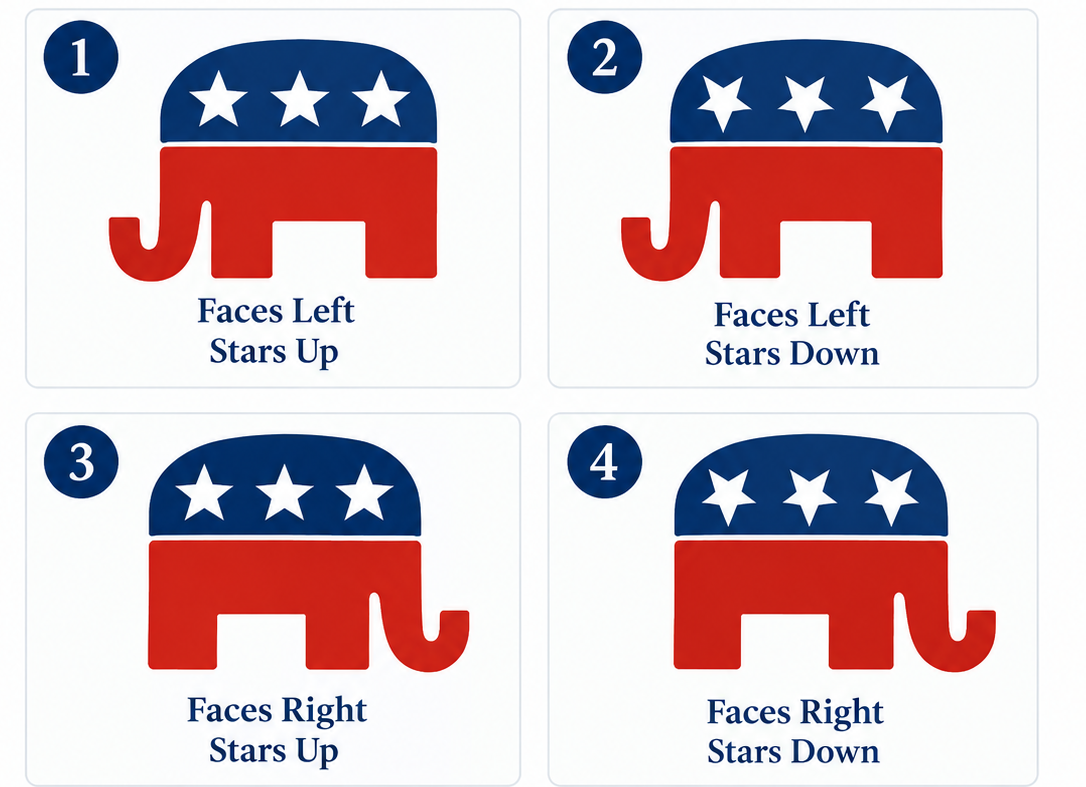
Will the real elephant please step forward? ☺
Why this site exists
The elephant has been associated with the Republican Party since the 1870s. Thomas Nast used an elephant to represent the Republican Party in an 1874 political cartoon, and the image became enduring political shorthand. Thomas Nast — Smithsonian.
Over time, the elephant has appeared in many forms. Modern versions include three stars. But two design details invite a closer look: the direction of the elephant’s trunk and the direction of the stars.
RepublicanLogo.com is a simple historical inquiry: follow the evidence, compare documented examples, and invite people to share what they find.
Two questions. Four possibilities.
Stars Up
Stars Down
Stars Up
Stars Down
Will the real elephant please step forward?
The purpose here is to examine the historical record rather than assume that one version is correct.
What we know so far
- The elephant came first. Thomas Nast featured an elephant in an 1874 political cartoon; Smithsonian records describe it as representing the Republican vote and identify the Republican National Party with the object. Smithsonian: “The Third Term Panic” (1874).
- The familiar logo evolved later. Smithsonian describes Thomas Nast as popularizing the elephant as a symbol of the Republican Party, while historical examples show the symbol appearing in different forms over time. Smithsonian: Party Symbols.
- That leaves two design questions. When did the three-star treatment become common, and what historical or official evidence establishes the direction of either the stars or the elephant? Smithsonian Magazine: Political Animals.
Share What You’ve Found
Please tell us about it if you have an old campaign button, convention program, photograph, advertisement, official document, or another dated example. The most useful clues are examples we can identify by source and date.
Keep me updated
Want to see what the historical trail turns up?
Note: This site is about the history and design of a political symbol—not an endorsement of a candidate, campaign, or political position.